Five categories of preserves exist in Iowa. Many designated areas qualify for preserve status in more than one category.
- Natural Preserves demonstrate Iowa's outstanding biological features. Some are excellent examples of the prairies and forests that once dominated the state. Others hold plants and animals now rare in Iowa. Dry bluff tops in the Turin Loess Hills form one of the few suitable habitats for one of Iowa's endangered species, the plains pocket mouse. Starr's Cave includes numerous types of ecosystems: mature deciduous woodlands, caves and creek beds. This preserve also marks the northern terminus of many plants typical of the Ozark Plateau.
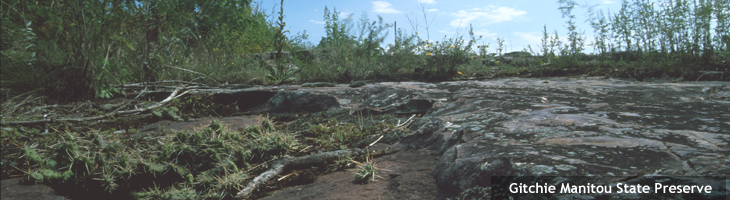
- Geological Preserves illustrate Iowa's ancient past. Distinctive and rare deposits or features are included. For example, at Gitchie Manitou, Sioux quartzite 1.2 billion years old protrudes from the earth. These are the oldest outcrops in Iowa. Another geological preserve, the Old State Quarry Preserve, was mined in the 1840's for limestone used in the construction of our original state capitol in Iowa City. Later, blocks of this unusually hard limestone were transported to Des Moines for the foundation of our present-day capitol.
- Archaeological Preserves give us a glimpse of the state's original inhabitants, the Native Americans who roamed this land from at least 12,000 years B.C. into the 1800's. Examples include Indian Fish Trap, a 200-foot long rock funnel used for fishing the Iowa River, and Wittrock Indian Village. The fortified village was occupied from 100 A.D. until changing climate and hostile neighbors forced abandonment 300 years later.
- Historical Preserves include significant structures or objects associated with early Euro-American occupation. Two such preserves are Fort Atkinson and Mt. Pisgah Preserve. Fort Atkinson is a federal military post built in the 1840s to protect Winnebagos from other tribes. In and near Mt. Pisgah, a Mormon pioneer way station and cemetery, 800 souls were buried in the mid-1800s.
- Scenic Preserves are selected for their outstanding natural beauty. However, most scenic preserves are valued for scientific merits as well. For example, one of the most scenic areas in northeastern Iowa, Bluffton Fir Stand Preserve, is noted primarily for its northern plant associations. This balsam fir stand, the largest in Iowa, reaches from the banks of the Upper Iowa River to the summits of bluffs 150 feet above. Canada yew, white pine and several other relics from glacial eras flourish here.
State Preserves Guide (Listing of all 95 preserves)
Dedication of a State Preserve
Preserves are established and overseen by a seven-member State Preserves Advisory Board, with the aid of state ecologists. Only carefully scrutinized lands are admitted to the State Preserves System. Each prospective area is visited to assess its scientific and educational qualities. All literature concerning the area is perused.
If an area is deemed worthy of preserve status, the landowner and preserves board enter negotiations. The two parties draw up a mutually acceptable document describing the land's qualities, stipulating acceptable land uses, administrative details, and providing a management plan to maintain the land's natural characteristics. The managing body (which is often a private owner, county conservation board, the state or a private conservation organization) is declared. These details vary from preserve to preserve, depending on the preserve's features and the owner's desires. However, all provisions must enhance the goal of preserving the area's special features. The signature of Iowa's governor formally dedicates the parcel into the preserves program.
Individuals and public agencies owning land with outstanding features are encouraged to consider dedicating the area into the state preserves system. Land may be dedicated in several ways. Some landowners dedicate land as a preserve while retaining private ownership. Some donate land to the state. The state may dedicate land already in state ownership.
Public Uses
State preserves are dedicated for the permanent protection of significant natural and cultural features. Most are open to hiking and photography. Many preserves are also wildlife management areas, purchased with hunting license fees and are open to hunting, fishing, and trapping. These preserves are posted as public hunting areas - please observe all posted rules. Activities prohibited on most preserves include; driving of motor vehicles, camping, fires, horses, removal of or damage to plants, animals, and other natural materials and archaeological and other cultural materials. Exceptions made on some preserves are posted. A few preserves are closed to the public because they are privately owned, because all access is privately owned, or for the protection of sensitive communities on the site. Where private land is involved, the landowner must be contacted and is not obligated to allow visits to the site. Many preserves are open to hunting. If a preserve is open to hunting, it is noted in the preserve narrative. All human burial sites in Iowa, including those on preserves, are protected. Intentional disturbance of burial sites is prohibited by Chapters 263B and 716.5 of the Iowa Code.
Trails
Many preserves do not contain officially established trails, but an informal footpath often leads from the parking lot toward prominent features. Most of the preserves are easily traversed without formal trails, especially the open expanses of the prairie preserves. Preserves that do contain officially established trails include Bixby, Brushy Creek, Casey's Paha, Catfish Creek, Cedar Bluffs, Gitchie Manitou, Little Maquoketa Mounds, Malanaphy Springs, Pilot Knob, Starr's Cave, and Woodland Mounds. The majority of the preserves are open only to foot travel, but two are open to horseback riding on designated trails: Brushy Creek and Pilot Knob. Canoeing is a great way to explore Cheever Lake (a boat ramp is provided).
Research Activities on the Preserve
Research related to the natural history and management of specific areas is occasionally funded by the Preserves Board. All researchers and collectors must obtain permission from the board before commencing a project.
Researchers working on preserves should report their results to the Preserves Board. Activities that include collecting or disturbance to the preserve require permission of the Preserves Board. The Board may be contacted through the Division of Parks, Recreation and Preserves, Department of Natural Resources, Henry A. Wallace State Office Building, 900 East Grand, Des Moines, Iowa 50319-0034.
Management Plans
The State Preserve System is intended to identify, protect, and maintain significant archaeological, historical, geological, biological, and scenic areas for Iowa's citizens. Planning efforts include general long-range planning, to determine what should be included in the system, and development of specific management prescriptions for individual preserves. The last "long-range" plan for the preserve system was written in 1978 and is presently being updated. Development of individual preserve management plans has recently begun to utilize the comprehensive approach and GIS technology used for state park ecosystem management plans.
For more information on preserve management plans, contact John Pearson at 515-669-7614 or:
Iowa Department of Natural Resources
Wallace State Office Building
502 E. 9th
Des Moines, IA 50319-0034
Active Requests for Proposals
Natural Areas Inventory
Threatened and Endangered Species
History of the Program
Legislation in 1965 created the Iowa State Preserves System to identify and preserve, for this and future generations, portions of our natural prehistorical and historical heritage, and to maintain preserved lands as nearly as possible in their natural condition.
By 2007, 94 parcels have been dedicated into the Preserves System. These preserves range from less than 1 acre to 845 acres and incorporate a total area of almost 10,000 acres. Some sites are owned by individuals or private conservation organizations. Others are owned by cities and counties; many are owned by the state. Preserves are managed according to plans developed cooperatively by the owner, the Preserves Board, the preserve manager, and DNR staff. Management may be handled by the owner or delegated to another group.
The Preserves Program is defined in Chapter 465C.1 of the Code of Iowa. This chapter describes a preserve as "an area of land or water formally dedicated ... for maintenance as nearly as possible in its natural condition though it need not be completely primeval in character at the time of dedication or an area which has unusual flora, fauna, geological, archeological, scenic, or historical features of scientific or educational value."
Preserves are meant to remain for centuries to come. Allocation to alternative purposes is nearly impossible. These parcels are not subject to the state's condemnation statutes. In the rare instance that an alternative use is determined to be of "imperative and unavoidable public necessity", a lengthy procedure allows removal of land from the Preserves System (including public hearings, joint action of both houses of the state legislature, and concurrence of the governor, Iowa Department of Natural Resources and the State Preserves Advisory Board).
State Preserves Advisory Board
Chapter 465C.1 also establishes the State Preserves Advisory Board. This Board has seven members, six appointed by the governor plus the director of the Department of Natural Resources (DNR). The Board advises the DNR on acquisition, dedication, and management of state preserves.