
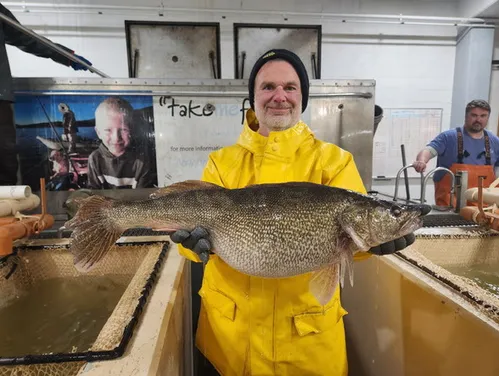
Walleyes spawn once a year using water temperature and photoperiod (length of day) as cues to spawn. Iowa Department of Natural Resources (DNR) crews captured 2,106 adult female walleyes at Rathbun, Spirit, and Storm lakes, as well as on the Mississippi River.
“The 2026 walleye netting season represents another highly productive and efficient broodstock collection season,” said Jay Rudacille, DNR Warm and Coolwater Fish Culture supervisor. “DNR crews collected enough females to meet our egg quota in 12 combined nights of netting operations at four locations across Iowa.”
Crews began netting operations on Rathbun Lake on April 6, while gillnetting at Storm Lake started on April 8. Operations at Spirit Lake began the night of April 10. The last night of netting was April 13, but the spawning of fish continued as “green” females ripened in the hatchery until egg quotas were met.
“Our goal was to collect 1,173 quarts of walleye eggs to produce over 106 million walleye fry (newly hatched fish) that we can stock in Iowa lakes or raise to a larger size in hatcheries before being released,” Rudacille said. “In total, 1,254 quarts of walleye eggs are currently hatching or are being incubated.”
Along with some walleye adults that stay at the hatchery all year long, netting crews collected enough walleyes to produce 491 quarts of eggs at the Rathbun Fish Hatchery. Crews working at Spirit Lake collected females that produced 445 quarts of walleye eggs now incubating at Spirit Lake Fish Hatchery. Storm Lake crews spawned enough females to produce 318 quarts of walleye eggs. The Storm Lake satellite hatchery transferred their eggs to the Rathbun and Spirit Lake fish hatcheries to be incubated and hatched.
“The walleye population in Rathbun Lake is at a 20-year high, with broodstock abundance and biomass at or in excess of management goals” said Mark Flammang, Rathbun District Fisheries Management biologist. “This is mostly due to good to excellent fry survival over the past several years, as well as relatively dry conditions the past few years. Little floodwater discharge helped to keep our walleyes where they belong, in the lake.”
Further evidence of the strength of walleye populations in lakes where broodstock are collected for spawning purposes are the number and size of walleyes collected in Storm Lake. “Our female walleye averaged 23.2 inches, which is the highest average since 1989, and almost a quarter (22 percent) of those were 25 inches and above,” shared Lake View District Fisheries Management biologist, Ben Wallace. “The walleye population in Storm Lake is strong and the fish are exhibiting great body condition.”
“Spirit Lake offers anglers incredible opportunities to land large, 25- to 30-inch walleyes,” explains Andrew Carlson, Spirit Lake District Fisheries Management biologist. “The northern pike population is as robust as it's been in years. Spirit Lake has an abundant, healthy muskellunge population with many large individuals more than 40 inches.”
Operations to collect walleyes for spawning purposes on the Mississippi River went very smoothly this season. “Mississippi River walleye populations are phenomenal and have been for some time,” Rudacille said. “This population is naturally reproducing and self-sustaining and not dependent on annual stockings like the walleye populations in Iowa’s lakes and reservoirs.”
Efforts to produce 106 million walleye fry is a team effort with most DNR Fisheries employees having a role in the project. “Many employees work a night shift during this season to collect walleyes into the wee hours of the morning,” Rudacille said. “Several employees work at stations more than 100 miles from their homes and away from their families during collection efforts.”
Participation in the annual walleye broodstock collection and spawning operations extends outside of the Fisheries Bureau. Entities outside of the DNR play an important role in this “once a year” operation. DNR staff from Fairport Fish Hatchery and the Bellevue Fisheries Station teamed up with staff from the fish hatchery associated with the Quad Cities Clean Energy Center just north of Cordova, Ill., as they have for several years.
Personnel from DNR and the Quad Cities Fish Hatchery joined forces to collect broodstock and spawn fish to meet egg quotas for both facilities. This team worked collaboratively to produce 120 quarts of eggs from Mississippi River females that were transferred to Rathbun Fish Hatchery for incubation and hatch. Fry hatched from these eggs will be used in an important research project comparing their survival rate to fry produced from lake strain females.
Iowa is one of the top producers of walleye fry in the United States, surpassed only by Minnesota in annual production. While some walleye eggs have already hatched, hatchery staff will keep a watchful eye over the remainder of the eggs during the 12-21 day incubation period. Walleye fry will be stocked into 34 public bodies of water and eight watershed rearing ponds. While the majority of walleyes are stocked as fry, some are cultured in Iowa DNR hatcheries and stocked at different sizes. Two-inch walleyes will be stocked into rivers and streams across Iowa this summer. Larger fingerlings (8- to 9-inch) will be stocked in lakes later this fall.
With little natural reproduction in most Iowa lakes and rivers, Iowa’s walleye populations depend on stockings. Walleyes are stocked throughout Iowa into natural lakes, interior rivers, flood control reservoirs and selected larger man-made lakes.