
Options for Disposal of Dead Animals
Dead livestock must be disposed of as soon as reasonably possible by rendering, incinerating, burying, or composting. “Reasonably possible” is generally considered to be within 24 hours of death.
Rendering
If the facility is not on a regular route, the producer should contact the rendering service as soon as possible to arrange for pickup of any dead animals. Though a dumpster or “dead box” is not required, they are recommended to help prevent runoff and scavenging.
Landfill
Contact your local sanitary landfill to determine if they accept dead livestock.
Burning/Incineration
Dead livestock may be incinerated in an engineered incinerator. Homemade incinerators may not be used. Open burning of dead livestock is not permitted. Contact DNR’s Air Quality Construction Permitting Helpline (1-877-AIR-IOWA, 1-877-247-4691) for permitting assistance.
Composting
Composting should be done on an all-weather surface of compacted soil or granular aggregates, asphalt, concrete, or other similarly impermeable material. Though not mandatory, a roof over the compost structure is recommended to prevent excess moisture accumulations and runoff. Incorporate dead animals into the compost pile and completely covered within 24 hours of death.
Additional recommendations include maintaining a base layer 12-24 inches thick, depending on the size and number of dead animals, and using 6-12 inches of bulking agent between carcasses and an additional 12 inches of cover material to reduce leachate, odors, and scavenging. Measures must be taken to prevent water from running into the pile and prevent leachate from leaving the composting facility. Limit storage of finished compost to 18 months, and land apply finished compost to cropland in a manner that minimizes runoff.
Additional best practices from Iowa State University Extension & Outreach:
Burial
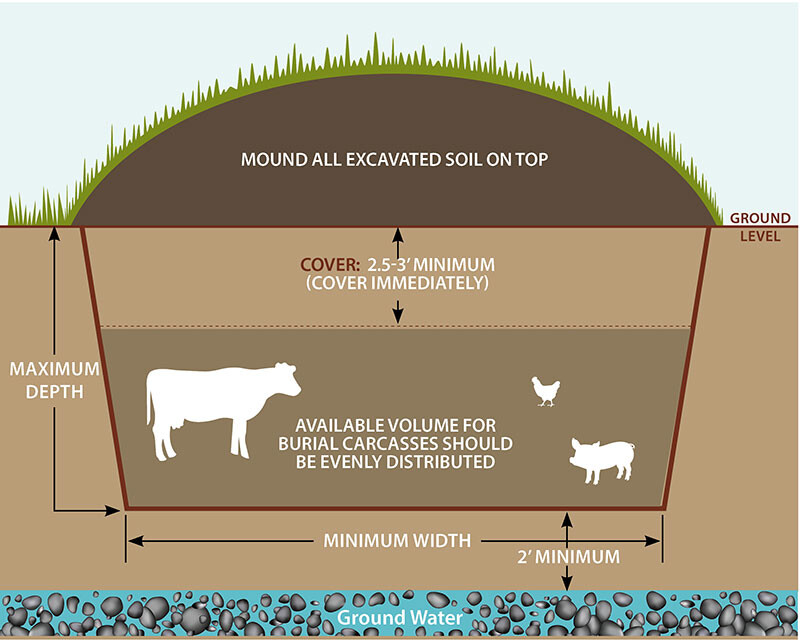
Burial should be in well drained soils and be at least 2 feet above the highest groundwater elevation. To determine if an area is suitable for burial of livestock, use our online mapping tool for Burial Zone Siting. Ensure that the Regulatory layer is turned on, which will show any areas where burial should be avoided. The Advisory layer shows areas of high, medium, and low risk for burial.
Standard burial trench design:
Mass Mortality Events
The Iowa DNR partners with producers and local, state, and federal agencies to plan for and respond to mass mortality events.
For additional information see the Iowa Department of Agriculture and Land Stewardship – Animal Disease Response and DNR's Disaster Assistance web pages.
- Cattle (3.25 MB).pdf - quick guide for cattle producers
- Swine (3.28 MB).pdf - quick guide for swine producers
Poultry (2.99 MB).pdf - quick guide for poultry producers