

Add winter wonder to your yard or acreage
Spruce up your yard or acreage with these trees and shrubs that will look good all year long.
- White pine - The only common pine in Iowa, the white pine has long narrow cones and soft plumy grass-like needles in bundles of five. Its curved upper branches provide beautiful asymmetry. The white pine will grow 50 to 75 feet tall and likes well-drained, sandy soil. Widely used as Christmas trees.
- White spruce - With dense foliage and a pyramid shape, the white spruce can withstand extremes of heat and cold and grows to be 40 to 60 feet tall. Attracts colorful winter finches.
- Redosier dogwood - This shrub grows from 10 to 15 feet tall and displays vibrant red stems, attractive cream flowers and white berries. It tolerates wet soil well.
- Gray dogwood - Its white flowers, white berries and blue-green foliage provide great winter interest. This shrub tolerates wet soil and will grow 10 to 15 feet tall.
- Ninebark - This shrub keeps things interesting in the winter with its brown shaggy peeling bark and white to slightly pink flowers. It’s drought tolerant and grows 5 to 9 feet tall.
You need to wait until spring to plant the pine and spruce. The shrubs can still be planted yet this year until the ground freezes.
Real Christmas trees are a renewable, recyclable resource
For many families, picking out their traditional REAL Christmas tree at an Iowa choose-and-harvest farm has become an annual event. Getting the family together revolves around warm, peaceful traditions that sometimes date back generations.
There are approximately 100 choose-and-harvest farms in Iowa. The top selling Christmas trees in Iowa are Scotch Pine and White Pine. Eight varieties of Christmas trees grow well in Iowa. Find a tree farm near you.
- Scotch Pine - an Iowa favorite. needles are 1 to 2/12 inches long
- White Pine - fluffy and very soft to the touch; needles are usually 2 to 3 inches long
- Fraser Fir - branches are great for hanging heavy ornaments; deep green needles with a silver/blue back are about 1 inch long
- Blue Spruce - commonly used in windbreaks; silvery blue to green needles are 1/2 to 1 inch long
- Douglas Fir - an old fashioned traditional tree with short needles; branches are great for heavy ornaments
- Concolor Fir - a popular nursery tree; light green, flat needles are 2 to 3 inches long
- Balsam Fir - has a dark green appearance, an attractive form and lasting needles; retains its pleasing fragrance
- Canaan - similar to the Balsam and Fraser Firs with dark green needles and a silvery underside
Essential Fall tree care tips
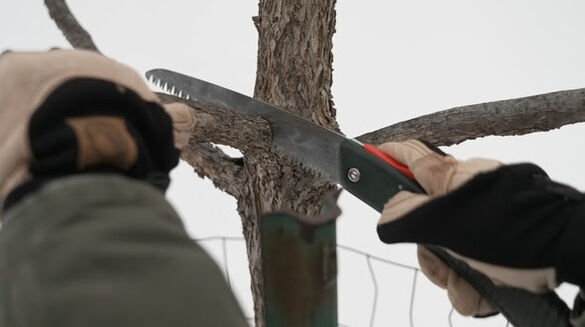
Seasonal fall temperatures and lack of snow make it perfect conditions to work in your yard or timber areas.
Late fall to winter is a great time to prune trees. Insect and pathogens are in dormant stages with colder weather. When trees start to grow next spring, they will start to produce wound tissue to cover the cuts, reducing the chance of insect and disease problems. Leaves are gone off the trees making structural pruning much easier. Without the leaves on it is easier to see co-dominate leaders, crossing or rubbing branches, and branches with poor branch angles. Branches on trees in your yard should be removed before they are much thicker than your thumb. Try not to remove more than a quarter of the crown.
Water your trees deeply and less frequently to encourage deep root growth and make them more resilient. Water during the early morning to minimize evaporation and freezing. It gives your trees more time to drink up.
Invasive bush honeysuckle and buckthorn trees are easy to spot through the woods in the fall. Their leaves remain green late into the season after everything else has fallen off, and often remain attached as late as Thanksgiving. Pesticides applied to cut surfaces work best this time of year as sap is being translocated to the roots.
Trees for Kids grant applications due January 8
The popular Trees for Kids grant program is accepting applications through January 8, 2027.
Grantees can be awarded up to $2,500 to purchase trees and mulch from Iowa nurseries. All trees for this program must be planted on public community grounds (park, community center, public school, etc.) Youth are required to be engaged in the process, most often helping to plant the trees on site.
Studies show trees planted around schools and in neighborhoods give youth increased levels of concentration, lower levels of aggression, lower levels of obesity and fewer symptoms of ADHD.
To apply for the grant, visit: www.iowadnr.gov/urbangrants.