
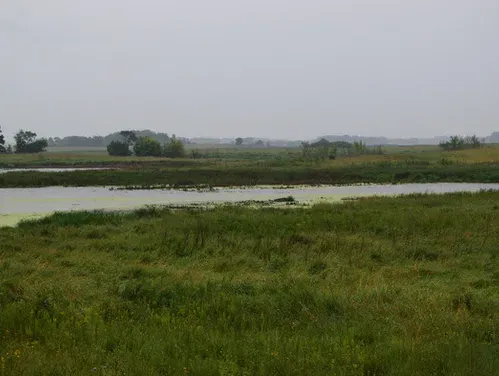
There may not have been a wildlife area in the state more quickly assembled than Pilot Knob Wildlife Area, in Winnebago County.
Between 2018 and 2022, 11 parcels covering 710 acres of rolling hills and wetlands were acquired from local landowners who enrolled their land in the federal Wetland Reserve Easement Program or the Wetland Reserve Enhancement Program.
For a project of this size, a lot of partners had to come together to make it happen, including the U.S. Fish and Wildlife Service, Winnebago County Conservation Board, the USDA’s Natural Resources Conservation Service (NRCS), the Iowa Natural Heritage Foundation, and the Iowa Department of Natural Resources (DNR).
“Local landowners were open to it – the ground was tough to farm and converting it to wetlands and prairie made sense,” said Rob Patterson, wildlife biologist with the Iowa DNR’s Clear Lake Unit.
On this soggy and rainy mid-August morning, Patterson pulled in to a gravel parking lot overlooking some of the developing wetlands and prairies.
“The rolling hills are a cool part of the landscape,” he said. “This area is in the oak savanna part of the state and we lost the oaks when it was converted to farm ground. To try to recreate that savanna, we included oak acorns with the prairie seed mix when it was seeded. We won’t manage this area any differently and will see what the oaks do.”
While all the parcels are not contiguous, the total complex covers more than 1,000 acres with 850 acres seeded to highly diverse restored prairie, and 170 acres of restored wetlands. The land is in the Winnebago River watershed and is near Gabrielson Wildlife Area, which is less than a half mile south of Pilot Knob State Park. There is an IHAP component as well – a 500-acre block of public land, adjacent to a 360-acre block of private land.
Deer, turkeys and pheasants are here and this new area benefits grassland birds, waterfowl and water quality.
Patterson said they created a landscape level management plan prioritizing oak savanna and grassland conservation and because of that, management here is fire heavy.
Pilot Knob State Recreation area on the north edge of Pilot Knob State Park look similar to each other but the difference is hunting is allowed on the recreation area.
“The state recreation area has remnant habitat on it that has never been farmed, which is pretty unique for this part of the state,” Patterson said. “It’s a popular spot for deer and turkey hunting, and with mushroom hunters.”
Driving through the park, two hen turkeys with about a dozen poults of different ages appear out of the timber and begin running on the road ahead of Patterson, dodging raindrops and seemingly reluctant to re-enter the timber.
“People are noticing this area,” he said. “They like the size and habitat variety and its proximity to Forest City.”