
Meet Chronic Wasting Disease Outreach Specialist, Catherine Cummings
Catherine is in a joint role with Iowa State University Extension and Outreach and Iowa DNR to serve as a Chronic Wasting Disease (CWD) Outreach Specialist. She delivers presentations about CWD mitigation and management to relevant stakeholder groups and serves as a resource for communities across Iowa. Catherine travels across the state to interact with County Conservation Boards, hunters, and landowners in CWD-affected counties to continue educating the public about deer diseases in Iowa. She also runs the Iowa DNR's incentive hunt in Allamakee County, where she assists the Iowa DNR wildlife staff with the collection of CWD samples during the hunting season.
Data Set, Graph, Learning Tools
Chronic Wasting Disease (CWD) is a 100% fatal disease that is caused by a misfolded protein and affects cervids across the world. CWD is spread through the bodily fluids of infected individuals and requires either deer-to-deer contact or contact with a contained environment to spread. CWD is unique in the fact that infected deer often appear healthy and are able to spread the disease. About 1 ½ to 3 years after infection is when the animal begins to show clinical signs of the disease and ultimately dies suddenly after clinical signs appear. There are currently no preventions, treatments, or cures for the disease.
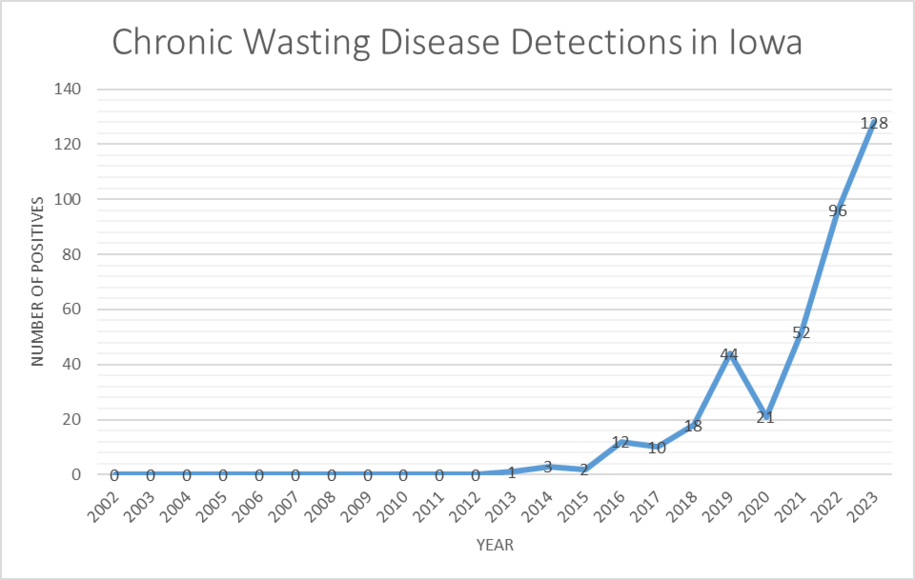
The Iowa DNR has been testing white-tailed deer for this disease since 2002. Surveillance allows the DNR to have a better understanding of the distribution and prevalence of the disease. CWD was initially detected in a wild white-tailed deer in Allamakee County in 2013, but has now been detected in 26 counties.
Based on how the disease has progressed in other states, we expect to see a slow progression in the number of positive detections for the first 6 to 10 years after detection. Once the disease becomes established, we expect to see exponential growth. Based on the number of deer that have tested positive for CWD over the past few years, we are beginning to see the exponential growth in disease prevalence.
Starting in 2020, the DNR began using a weighted surveillance program that focuses on promoting efficiency by incentivizing samples from “high value deer” (e.g., adult bucks–older deer and bucks are more likely to have the disease).
Chronic Wasting Disease (CWD) in Wild Deer in Iowa Interactive Dashboard
- First tab - see historic CWD detections across Iowa. You can click on each year in the bar graph and see where CWD was detected for that year.
- Second tab - most recent sampling year; shows the number of “confirmed CWD” detections and the number of “suspect CWD” detections. Suspect positives are initial detections that have yet to be confirmed by secondary testing
- Third tab - different statistics looking at sex and age prevalence rates. You can filter for historically or annually.
- Fourth tab - Historic sampling for state and also county. You can see the number of deer tested since 2002 and the number of deer that have tested positive.
Learn More
For more information or questions, please contact [email protected]