
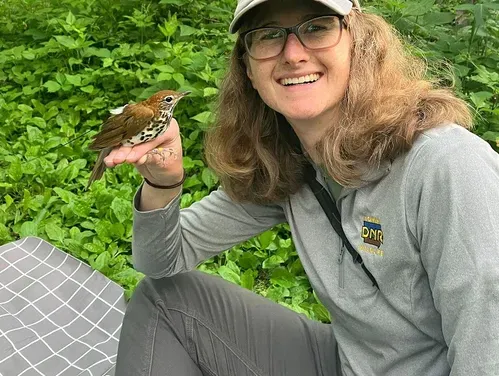
Meet Riggs Wilson, DNR Wildlife Research Specialist and Anna Buckardt Thomas, Avian Ecologist
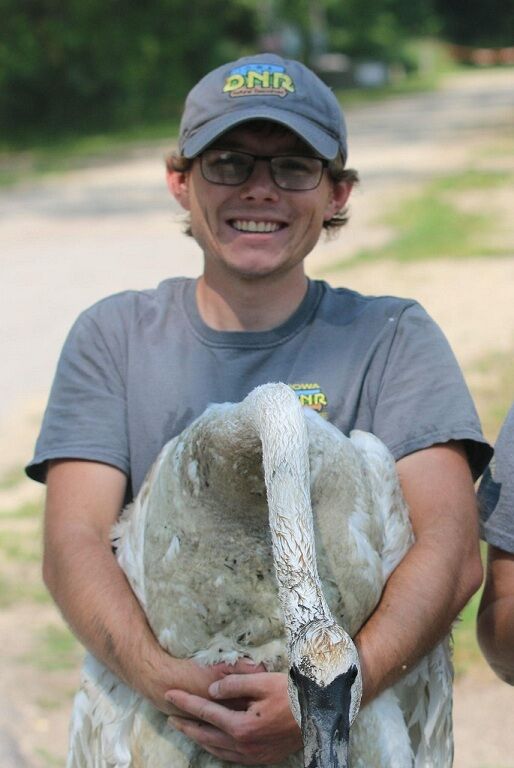
Riggs is a Wildlife Research Specialist in a partnership position with the Wildlife Management Institute and the Iowa DNR in the Iowa DNR’s Wildlife Diversity Program. He has been in this role since 2023. The DNR’s Wildlife Diversity Program focuses on Iowa’s non-game wildlife species, meaning all of Iowa’s native wildlife that are not hunted, fished, or trapped.
Riggs assists with a variety of programs and projects focused on Iowa’s non-game wildlife, including the Osprey and Peregrine Falcon volunteer nest monitoring programs, Iowa’s Motus Wildlife Tracking Network, owl and nightjar surveys, Bumble Bee Atlas surveys, bat guano surveillance for White-nosed Syndrome, and data analysis. He is originally from southeast Iowa and earned his bachelor’s degrees in Animal Ecology and Forestry and a master’s degree in Wildlife Ecology, all from Iowa State University. For his master’s thesis, he studied Northern Bobwhite occupancy and habitat associations on the landscape scale across southern Iowa using passive acoustic monitoring units.
Anna is the Avian Ecologist (AKA bird biologist) for the Iowa DNR’s Wildlife Diversity Program, which focuses on conservation, monitoring, and research of all Iowa’s wildlife species, with a focus on species that are not hunted, trapped, or fished. Anna received her B.S. from Michigan Technological University where she double-majored in Wildlife Ecology and Management and Applied Ecology and Environmental Sciences. She went on to earn an M.S. in Wildlife Ecology from the University of Maine. Her thesis research focused on American Woodcock and Golden-winged Warbler abundance in managed young forest habitats in northern Wisconsin and on the migratory ecology of Golden-winged Warblers. She has worked for the Iowa DNR for 7 years with her work revolving around Iowa’s birds. Some of her major projects include coordinating the DNR’s Motus Wildlife Tracking Network, owl and nightjar surveys, and the Bird Conservation Areas program. She also provides technical assistance to staff, partners, and the public on all things bird-related.
Data Set, Graph, Learning Tools
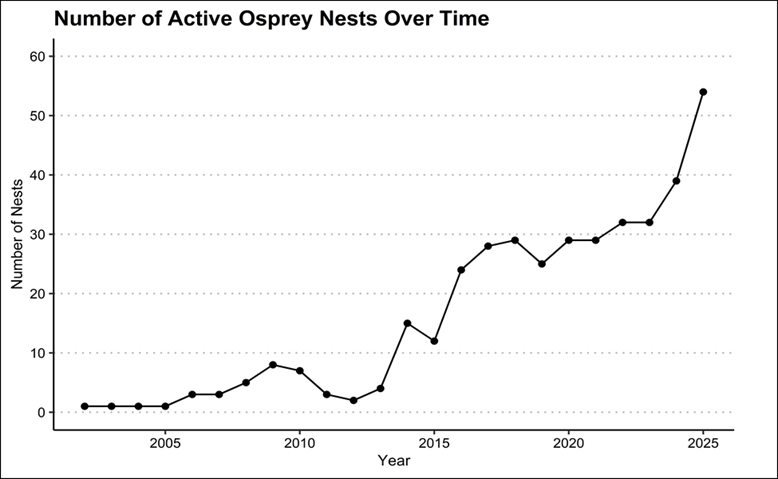
Osprey (Pandion haliaetus) are a migratory fish-eating raptor and a conservation success story in Iowa. Iowa’s Osprey restoration program began in 1997 and involved translocating young birds from Minnesota and Wisconsin to strategic locations across Iowa. The last year that birds were released was 2016, currently the objective is to monitor nesting activity. Nest monitoring volunteers visit the nests during the breeding season and gather information on nest activity at the start of the nesting season in April and whether the pair is successful in fledging young (young leaving the nest) towards the end of the nesting season in late July/August. The Iowa Osprey population continues to increase, with a record 70 monitored nests (54 active nests) during the 2025 nesting season.
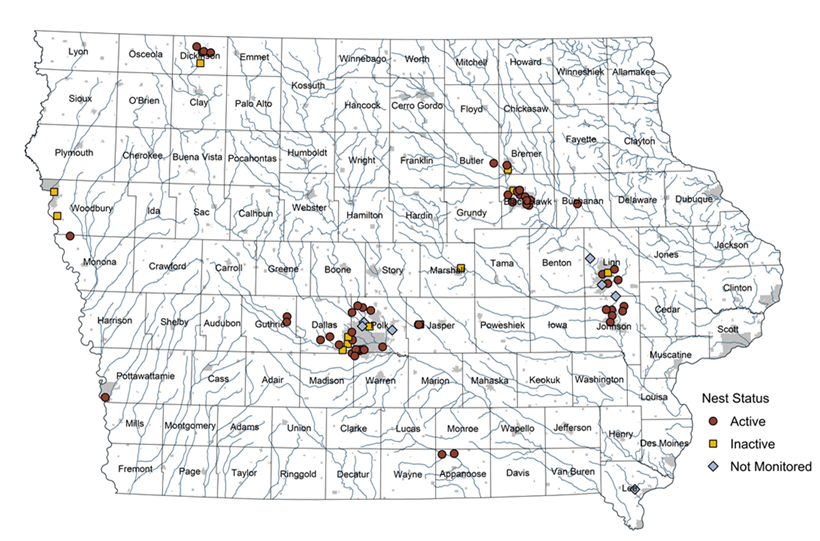
The majority of new nests monitored in 2025 were in the Des Moines Metro and in Blackhawk county near Cedar Falls and Waterloo. These areas have plenty of water resources for foraging on fish, and no shortage of tall structures, like cell towers, for nesting. Osprey are semi-colonial nesters, meaning they prefer to nest in loose colonies with other Osprey pairs, often returning to the general area where they were hatched and raised. The increase in active nest sites in these areas is likely due to the return of adult birds that successfully fledged from nearby nests in recent years.
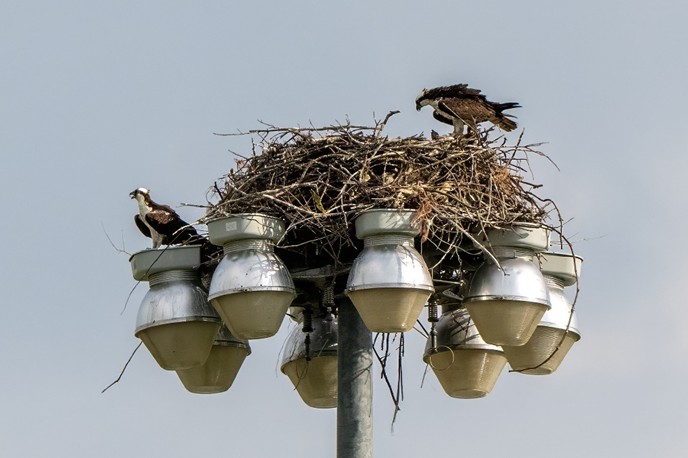
As the number of Osprey nesting in Iowa continues to increase, we have seen an increase in the number of Osprey nesting on cell towers, with over 81% of the 2025 active Iowa nest sites located on cell towers. Osprey that are hatched in a nest on a tower, are more likely to build a nest on a tower when they start breeding around 3-4 years old. Osprey don’t generally cause damage to the towers, but conflicts can arise when work must be done on a tower during the nesting season. The tower companies work with the DNR to properly handle these situations to benefit both the people and the birds.
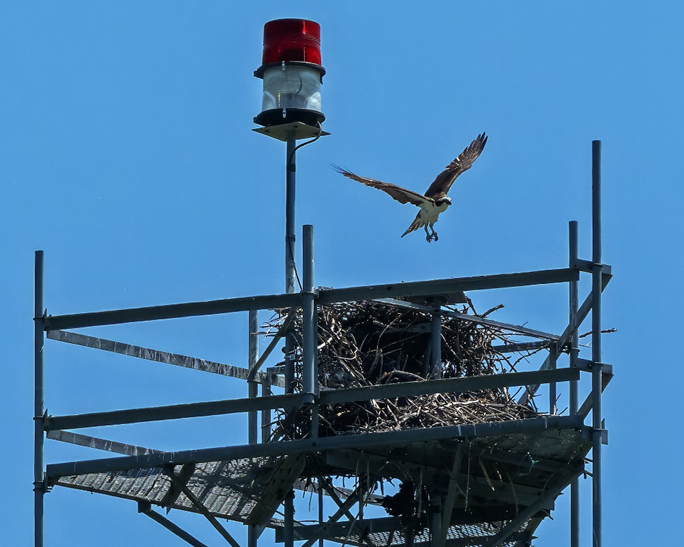
Ospreys are an Iowa conservation success story and continued monitoring is important to help us understand this growing population.
View the full 2025 Iowa Osprey nesting report online.
Learn More
For more information or questions, please contact [email protected]