
Meet Lewis Bruce - DNR Fisheries Research Biologist
Lewis is a Fisheries Research Biologist with a focus on small impoundments. He earned a BS in Wildlife and Fisheries Sciences from South Dakota State University. Lewis has worked on the Small Impoundment Research Team for the past 21 years. This team works on projects geared towards improving angling opportunities in Iowa’s small impoundment fisheries. Working with fish is a big piece of his job responsibilities, but learning about anglers and their needs is also an important aspect of his job.
Data Set, Graph, Learning Tools
Estimating fish ages and measuring fish growth is a common technique fisheries professionals use to make management decisions about fish populations. Estimating fish age is similar to counting the rings of a tree. Slow growth in the winter provides a distinct line and the summer growth is the distance between the visible lines.
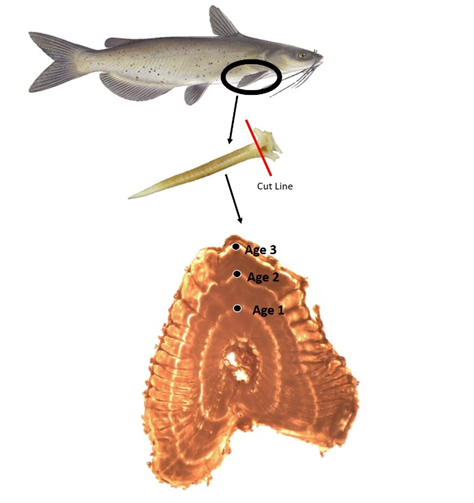
Annual growth is proportional to the fish's length-at-capture. Pectoral spines on Channel Catfish are a common structure used to estimate fish age and measure growth. The spine can be removed from the fish and released back into the lake after length and weight of the fish is recorded. The spine is cut and then placed under a dissecting scope where light illuminates the growth rings (annuli).
Fish age and length of an individual fish at time of capture can be plotted on a graph.
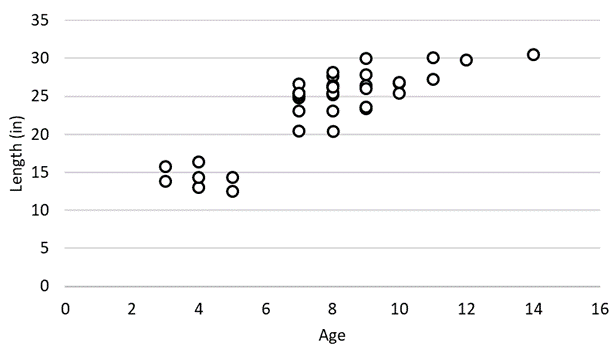
The data above provides a snapshot of the Channel Catfish population in Cherry Glen South Pond located in Ankeny, Iowa. These data show Channel Catfish in Cherry Glen South reach an old age and anglers are not over harvesting or taking too many fish from this lake. Fish continue to grow each year, so this suggests the population is healthy and not overpopulated.
Learn More
For more information or questions, please contact [email protected]