
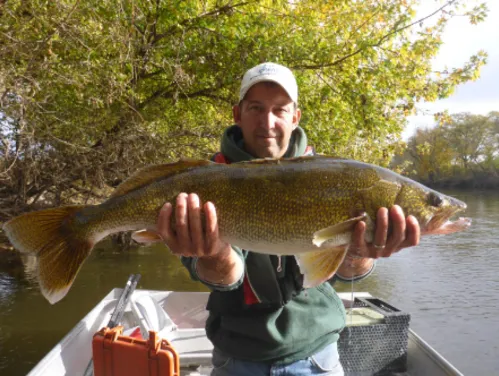
Meet Mike Siepker and Greg Simmons, DNR Fisheries Biologists
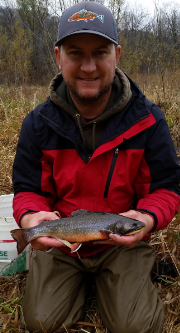
Mike Siepker is the Northeast Iowa Fisheries Biologist. He has a degree from Iowa State in Animal Ecology with an emphasis in fisheries and a Masters degree from University of Illinois.
Greg Simmons has a degree in fish and wildlife biology from Iowa State with an emphasis in fisheries. He is a part of the interior rivers research team located at the Northeast Iowa DNR office in Manchester.
Data Set, Graph, Learning Tools
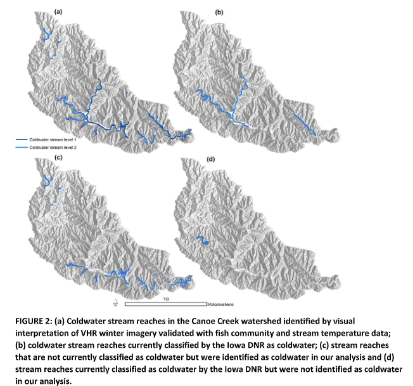
The interior rivers research team evaluates the use of very high resolution satellite imagery to detect the location and extent of coldwater streams in the driftless region of Northeast Iowa. By examining images from winter months, they were able to confirm the current coldwater designation of 23 km of stream in the Canoe Creek watershed, while also discovering an additional 34 km of stream that likely meets the evaluation criteria for reclassification from warm water to coldwater surface water status. This approach is currently being repeated for other watersheds in the driftless regions and will undoubtedly result in identification of more coldwater resources that should be reclassified.
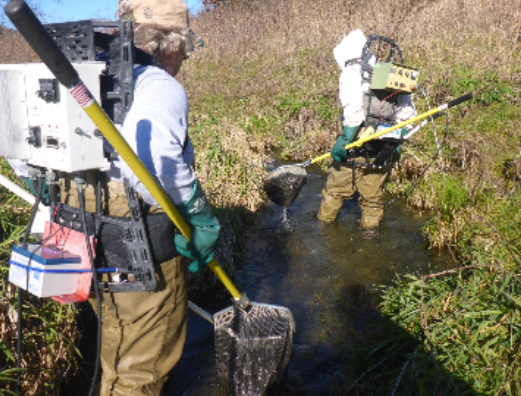
At a sampling site, the team looks for evidence of trout, checks for coldwater macroinvertebrates, and takes temperature samples to validate the stream classification.
Iowa has a current surface water classification system that either classifies as cold water or warm water. If sufficient data is collected to make a case for a coldwater stream reclassification, then it is submitted to the water quality section of the DNR for approval and then finally to the environmental protection agency( EPA) for final approval.
This classification is extremely important to the public and private landowners along the waterways. The reclassification allows the stream to be more protected legally(from city discharge, thermal pollution, warm water discharge…etc). Coldwater status also allows private landowners to seek financial assistance for EQIP and NRCS funding to improve habitat restoration projects on their properties. Reclassification also benefits the DNR as it gives more accurate information for stocking trout populations, making management decisions, and gives more fishing access to the public.
A coldwater stream research project was started about 5 years ago because many Northeast Iowa streams had not been researched thoroughly and may have been mislabeled as a warm water stream. Brook trout are the only native trout. The research team wanted to find places where brook trout exist and areas that could be restored. To find areas to restore, they needed to identify more potential coldwater stream habitats. The more identified areas the larger the efforts of population restoration.
Iowa Trout Streams with Natural Reproduction graphic (file name: Iowa Trout Streams with Natural Reproduction.png) Alt text: This graph shows the number of naturally reproducing trout streams in Iowa from 1980-2016.
Learn More
For more information or questions, please contact [email protected]